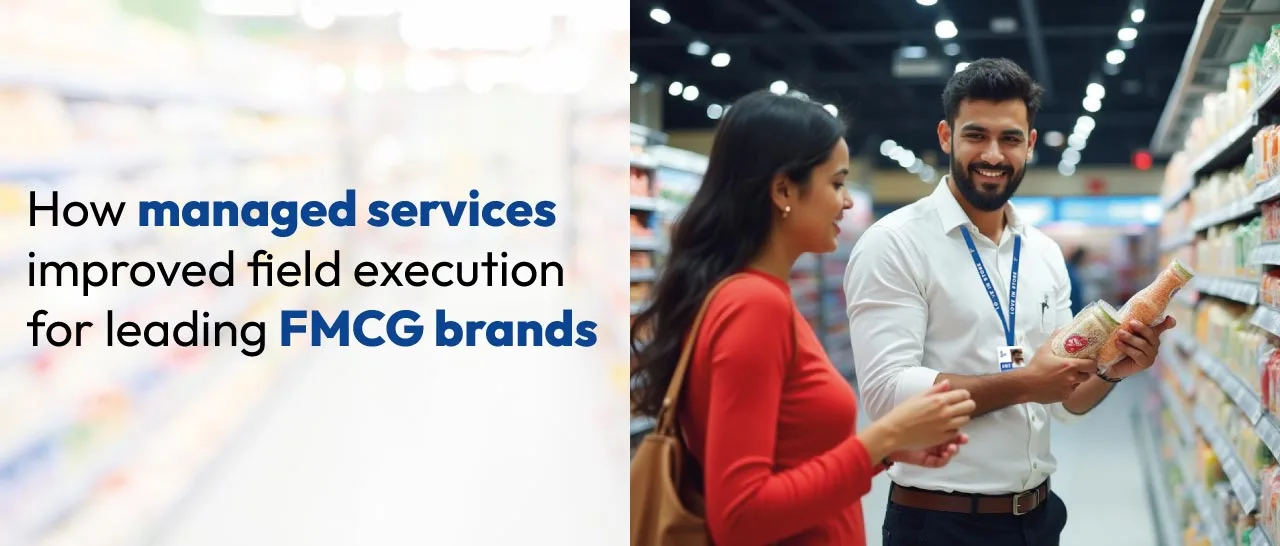

How managed services improved field execution for leading FMCG brands
As you know, a field sales job is tough to manage. In a fast-growing world of FMCG, success depends on speed, visibility, and execution at the last mile. FMCG is consistently challenged; no matter how strong the brand equity, marketing campaigns, or distribution networks are, growth eventually depends on the shelf.
For leading FMCG brands operating across India’s vast and diverse retail landscape, managed services have become a strategic solution to transform fragmented execution into a streamlined, measurable growth engine.
The Challenge of Traditional Field Execution
FMCG field sales operations are facing challenges. A salesperson or brand depended on multiple suppliers for handling stock visibility, gathering orders, checking the right pricing, confirming promotions, and getting market feedback.
And if you consider this number of regions, distributors, and product categories, the problem becomes enormous.
This is how the decentralized system usually created problems:
- There was a lack of uniformity in the execution of the regions.
- There was a lack of visibility into the promoter’s productivity.
- The reporting cycle was delayed.
- There were stock issues and a lack of planogram compliance.
It was difficult to scale up during peak periods.
Handling thousands of stores in the metro city markets and maintaining a standard becomes difficult.
What Managed Services Changed
Managed services become a centralized, accountable execution model. Instead of managing different tasks like recruitment, deployment, training, and reporting through separate agencies, brands started choosing a single expert agency for end-to-end management.
This integrated approach ensures that staffing, training, performance tracking, compliance monitoring, and reporting function as one cohesive system rather than disconnected activities.
Organizations such as Love In Store have further enhanced this process by integrating manpower expertise with technology-enabled reporting and scalability across the country.
Structured Manpower Deployment & Training
The execution of the process in the field largely depends on the quality of manpower. The managed services approach is centered on recruiting qualified promoters, merchandisers, and brand advisors who are also committed to the brand’s goals.
Love In Store enhances this process by:
- Category-specific recruitment
- Structured onboarding and product training
- Continuous performance evaluation
- Grooming aligned with brand positioning
This has resulted in FMCG brands showing enhanced in-store engagement, better shelf discipline, and improved conversion rates. Trained manpower in the field not only manages the inventory but also impacts purchasing decisions.
One of the most significant benefits of managed services is the aspect of transparency. Rather than waiting for the results of manual reporting, brands can now track results in real time.
Love In Store uses in-house technology and reporting tools to give brands insight into:
- Promoter attendance and productivity
- Shelf availability and planogram compliance
- Display execution and POSM tracking
- Store-level sales data
This allows FMCG brands to see where there are gaps in real time and make changes before it impacts sales. Compliance increases, stockouts decrease, and campaign results can be measured.
Nationwide Scalability Without Quality Loss
The Indian retail market requires scale and precision. Managed services enable brands to launch campaigns simultaneously in metros, tier-2, and tier-3 cities without compromising on execution quality.
Having operations in hundreds of cities, Love In Store enables brands to achieve synchronized execution, uniform brand presence, and flexible scaling during festivals or new product launches. This execution flexibility enables FMCG companies to sustain their momentum in fluctuating market scenarios.
Data-Driven Retail Decisions
Managed services help brands extract insights from ground-level activities. Brands don’t have to make decisions based on assumptions about what works and what doesn’t. They can evaluate store-level performance, consumer engagement trends, and competitor actions.
Love In Store’s systematic reporting and analysis capabilities help FMCG leaders maximize manpower use, improve merchandising plans, and maximize ROI. Field execution becomes predictive and less reactive.
Execution as a Growth Catalyst
Managed services at the end of the day optimize execution and improve outcomes. FMCG businesses can:
- Improve in-store presence
- Boost sales conversions
- Simplify operations
- Promote accountability
- Deliver measurable ROI at retail touchpoints
Love In Store, with its manpower expertise, technology-enabled monitoring, and centralized control, helps top FMCG players unlock field execution as a potent growth catalyst.
The Indian retail market requires scale and precision. Managed services enable brands to launch campaigns simultaneously in metros, tier-2, and tier-3 cities without compromising on execution quality.
Having operations in hundreds of cities, Love In Store enables brands to achieve synchronized execution, uniform brand presence, and flexible scaling during festivals or new product launches. This execution flexibility enables FMCG companies to sustain their momentum in fluctuating market scenarios.